How to start stamp collecting with one small themed page
- Cost to start
- ~$10-30
- Difficulty
- Beginner
- First result
- 60-90 minutes
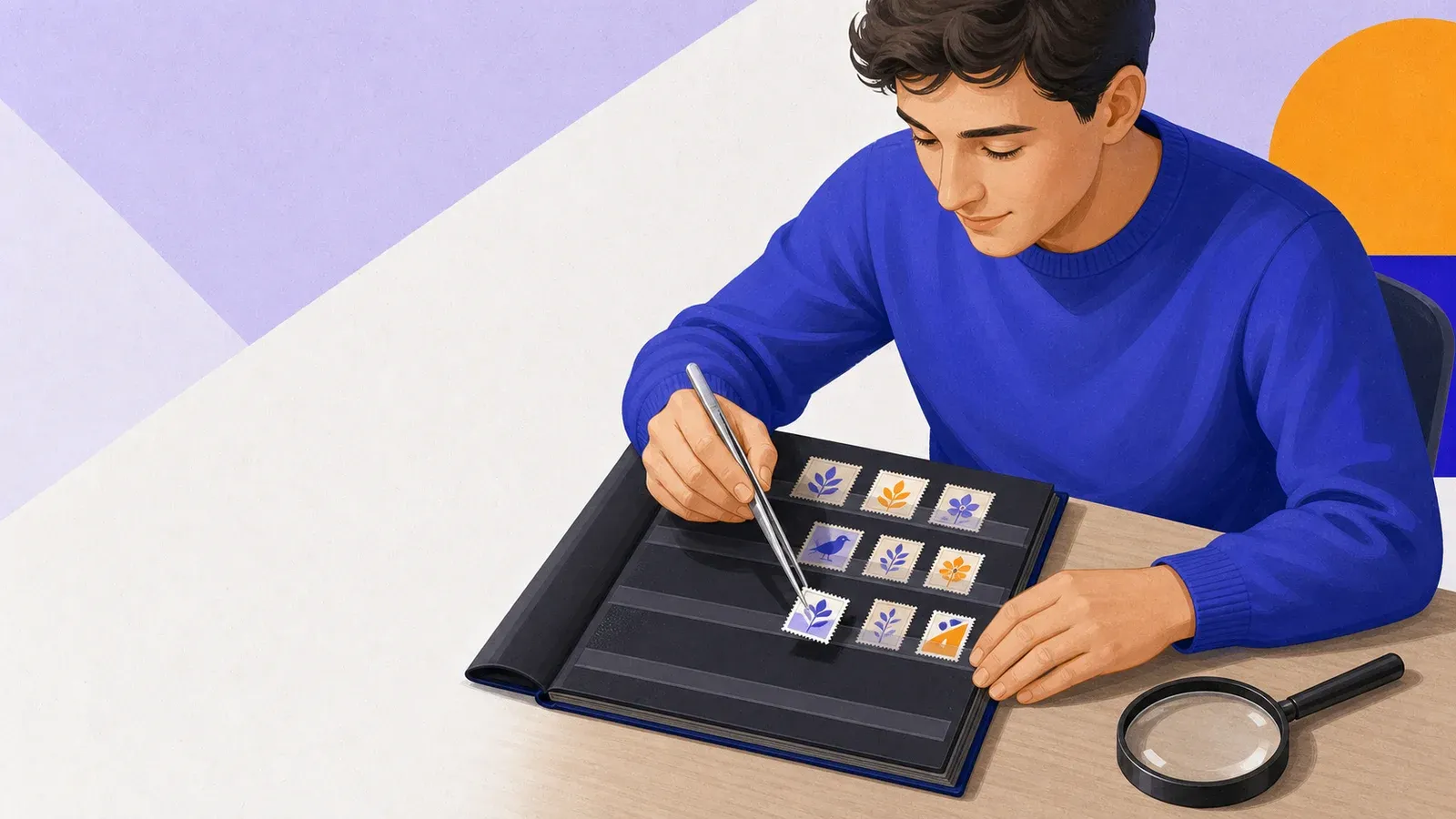
Tongs, stock book and magnifier
Observe before assigning an identity
One labeled 12-stamp stock-book page
Choose a small theme, handle common stamps safely, identify what you have, and arrange one useful stock-book page without chasing rarity or investment value.
What you need to know
-
Give the first page a 12-stamp boundary
Choose one modest topic, country, color or time span and stop at 12 examples. A small page teaches comparison without demanding completeness.
-
Handle dry stamps with proper stamp tongs
Smooth-ended tongs protect fragile paper from skin oil and pressure. Do not substitute sharp household tweezers or pick stamps up with bare hands.
-
Preserve whole covers and unfamiliar material
A postmark, route or envelope can carry evidence. Never soak an intact cover, an unused stamp, or an unfamiliar or self-adhesive issue on impulse.
-
Identify from several visible clues
Country, inscription, denomination, design, perforations, paper and cancel all matter. A similar picture or one catalog number is not proof.
-
Use pockets instead of tape or glue
A stock book holds stamps loosely behind strips so they can be rearranged. Sticky pages, tape and household glue can stain, thin or tear the paper.
Choose a 12-stamp theme
Pick a boundary you can explain in one sentence. “Birds on used stamps,” “blue stamps from one country,” or “mail connected with railways” gives you a practical sorting rule.
Handle and sort the 12 stamps safely
Clear a dry table, move food and drinks away and close windows or fans that could scatter light paper. Put down clean white paper and a dark card so pale and dark edges are both visible.
Build one useful stock-book page
Choose a clean stock book with purpose-made, non-adhesive pockets or strips. Avoid magnetic photo albums, pressure-sensitive pockets and any page that grips with adhesive. Never attach a stamp with household tape, glue, putty or a sticker.
Find a club and grow carefully
Take a page photograph and three precise questions to a local club, library group, show or specialist society. Ask whether your theme has a standard reference, whether an unresolved item should stay on cover and which condition features you missed.

Begin a focused collection
Identify and grow carefully
- National Postal Museum hobby toolsShows how collectors use references, perforation gauges, watermark tools, magnification, albums and mounts as questions become specific.
- APS beginner FAQAnswers common questions about low-cost material, topical research, dealers, inherited collections, valuation and clubs.