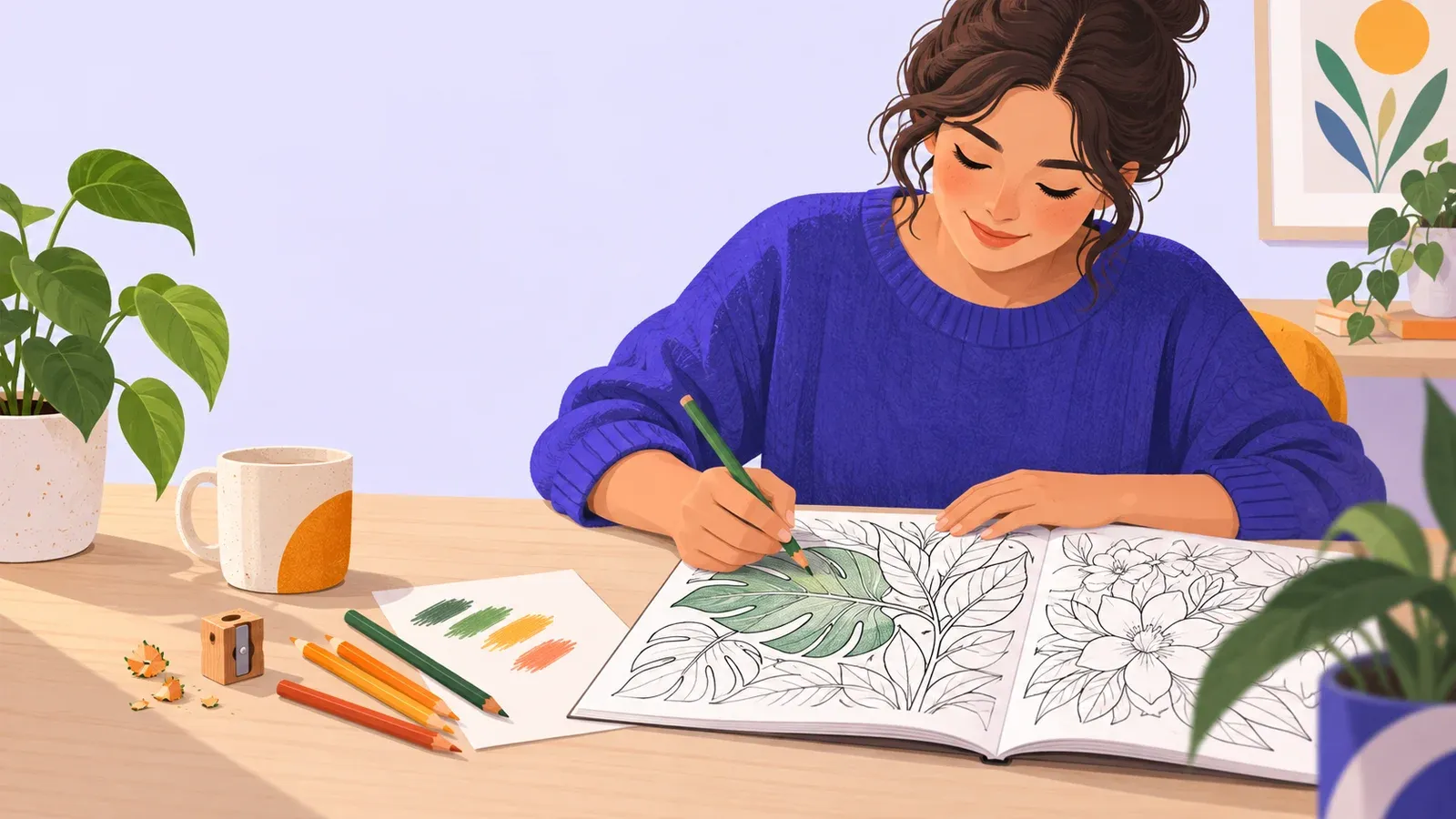
How to start coloring with a few pencils
- Cost to start
- $0 with existing supplies
- Difficulty
- Easy
- First result
- 30–45 minutes
Borrow pencils and use an authorized free printable
Start with broad shapes and a relaxed grip
Allow one session for a small motif
Color one flower or leaf with basic pencils, test your colors on scrap paper, and use light layers to build shading without denting the page.
What you need to know
-
Choose an open design
Use a coloring book you own or an artist's authorized printable with shapes at least a fingertip wide.
-
Gather basic supplies
Bring colored pencils, a sharpener, a soft eraser, and scrap paper; use supplies you already have.
-
Set up a comfortable spot
Put the page on a firm surface with good light and a spare sheet underneath to protect the next page.
Test a small palette
Pick one flower, animal, or group of leaves to finish today. Set aside three to six pencils, including a light and dark version of your main color. Try pale yellow, orange, light green, and dark green for a flower.
On scrap paper, make a light and a darker patch with each pencil. Layer one color over another to see whether you like the mixture. Keep that swatch beside your page.
Color one shape at a time
Begin with your lightest pencil. Hold it slightly farther back than you would for writing and make small overlapping circles. Keep the pressure light enough that you can still see the paper’s texture.
Choose which side will catch the light. Leave that edge pale, then add a second layer elsewhere. Use your darker pencil along the opposite edge and ease the pressure as you move toward the center. Turn the page whenever your wrist feels cramped.
Repeat on neighboring shapes, using some of the same colors. Pause after the motif and look at it from arm’s length before adding more shading.
Fix pressure and layering problems
For streaks, sharpen the pencil and add a light pass across the gaps. If the surface has become shiny and new color slides over it, stop layering that area; use less pressure on the next shape.
Dab stray marks gently with the eraser, testing first on your swatch. Some pigment will remain. Avoid scrubbing until the paper roughens. If your hand aches, loosen your grip and take a break.

Colored-pencil technique and palette ideas
- Princeton Art Museum pencil-palette workshopAn artist-led workshop demonstrating how to choose a group of pencil colors.
- Colored Pencil Society of America articlesSpecialist articles on colored-pencil materials and techniques for further practice.
- Sarah Renae Clark's five coloring tipsA video showing shading, highlights, texture, and palette choices on coloring pages.
