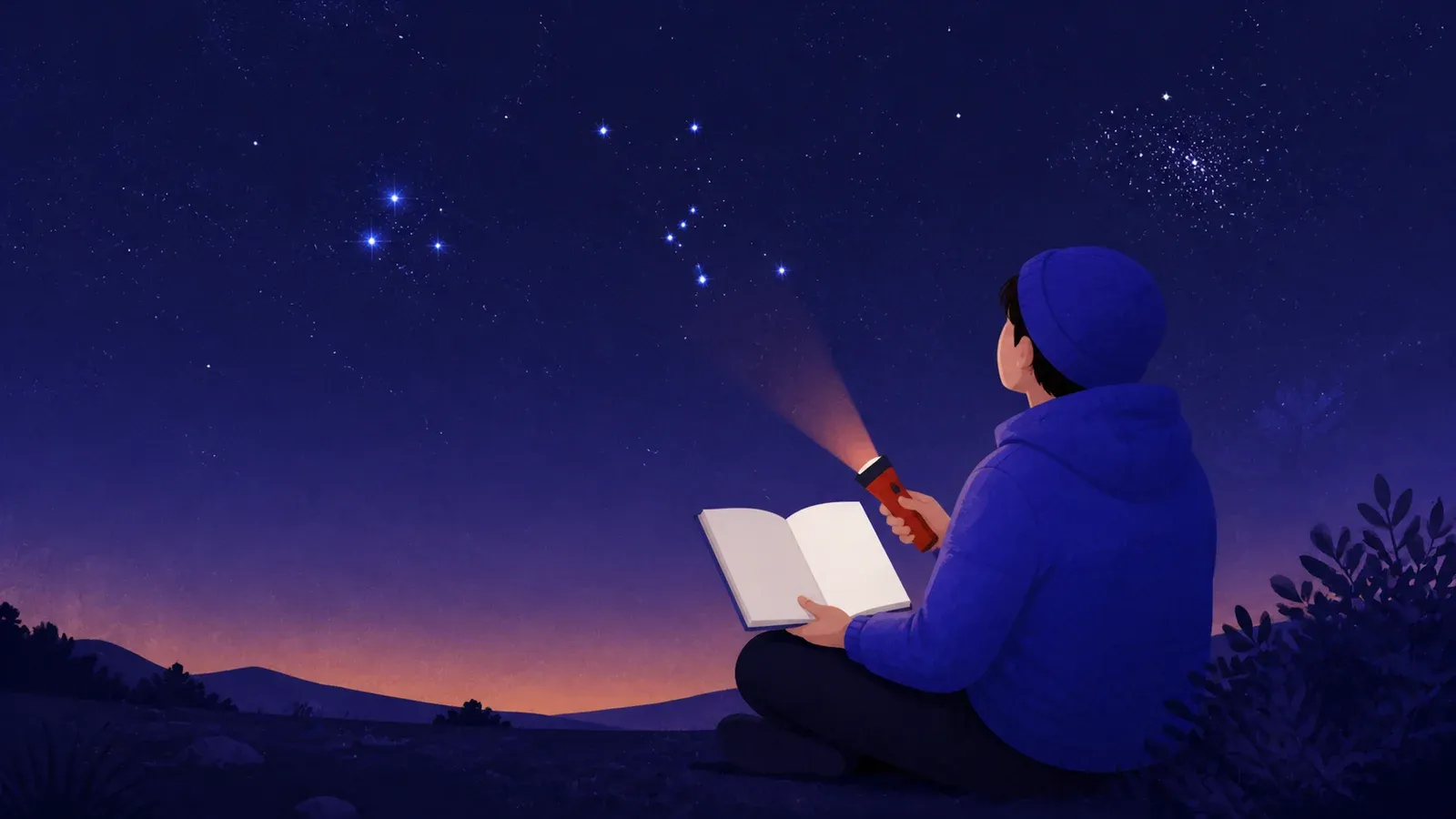
How to start astronomy with three night-sky landmarks
- Cost to start
- ~$0-30
- Difficulty
- Beginner
- First result
- 30-45 minutes
Chart, notebook and dim red light
Begin with the unaided eye
Three landmarks and a sky log
Plan a safe first stargazing session, find three reliable sky landmarks, keep a useful observing log, and delay buying a telescope until you know what helps.
What you need to know
-
Plan for one exact place and time
The visible sky changes with location, date and hour. Preview the session in a current chart instead of relying on a generic list of objects.
-
Use your unaided eyes first
Learn the horizon, directions and one large star pattern before adding magnification. These anchors make every later observation easier.
-
Choose a legal, familiar site
Check weather and closing hours, inspect the ground in daylight and bring a companion or tell someone where you will be and when you will return.
-
Protect night vision without risking a fall
Dim a red chart light while stationary, but use enough white light to cross roads, avoid obstacles and move safely whenever conditions require.
-
Never improvise solar viewing
Ordinary sunglasses are not safe for looking at the Sun. Never point binoculars or a telescope toward it without a correctly fitted front filter and expert guidance.
Plan one safe, specific observing session
Choose a familiar garden, balcony, courtyard or permitted public site with a broad view. A moderately light-polluted place is fine for learning bright landmarks. There is no need to make your first attempt a remote dark-sky trip.
Run a 30–45 minute first observation
Spend the first five minutes orienting yourself without magnification. Write the date, local time, location and weather, then sketch the horizon and label the four directions you can identify.
Keep a useful observing log
A useful log captures enough context to repeat the observation. For every session, include date and local time, location, weather, cloud and sky brightness, equipment used, target name or tentative identification, and a short description or sketch.
Avoid common mistakes and choose the next target
The most common beginner mistake is trying to see everything at once. A long checklist encourages hurried glances, while a bright screen erases the dark adaptation needed to notice faint detail.

Plan, observe and stay safe
- Sky & Telescope stargazing basicsA practical introduction to learning constellations with the unaided eye, using charts and choosing binoculars or a telescope later.
- NASA Night Sky Network first-telescope guideExplains why beginners should learn the sky, try club equipment and value a stable, usable instrument over advertised magnification.
- NASA Night Sky Network club finderFind U.S. astronomy clubs and public events where you can ask questions and look through several instruments before buying one.
- Astronomical League Universe SamplerA structured beginner observing program covering sky motion, angular distance, star-hopping and the details worth recording in a log.
- American Astronomical Society solar safetyCurrent expert guidance on safe direct solar viewing, certified filters and why unfiltered optical instruments can cause severe harm.

Apps for your phone
-
Stellarium Mobile
Set the correct location and time, preview three targets, then use red night mode outdoors; verify directions against real landmarks.
 App Store
 Google Play